
1. Whole-home water
2. Drinking water
3. Specifications
Your system at a glance
Mixed Bed L
Softening and carbon filtration in one main tank, plus drinking water at the kitchen.
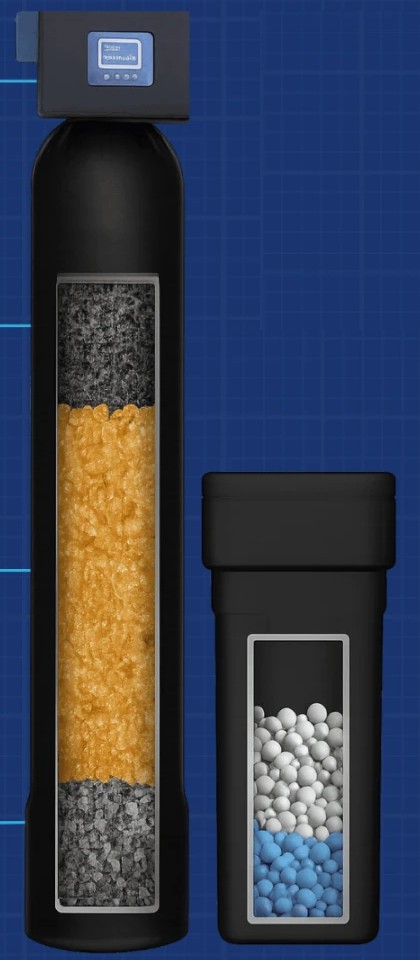
Inside the tank
- Carbon mediaTop layer
- ResinMiddle layer
- GravelBottom layer
Garage / utility area
Main tank
Carbon + softener
Brine tank
Holds salt
Kitchen sink
Under-sink RO
+ its own faucet
Simplified illustration — not to scale.
Step 1 of 3 · Whole-home water
What happens throughout the home
Every tap in the house gets water that has passed through one main tank holding two layers:
Carbon layer
Addresses chlorine and chloramine, and the taste and odor that come with them.
Softening layer
Removes calcium and magnesium hardness — the cause of scale and spotting.
Step 2 of 3 · Drinking water
Drinking and cooking water
A separate reverse-osmosis (RO) system goes under your kitchen sink and feeds its own dedicated faucet. It adds treatment for the water you drink and cook with — at that faucet only, not every tap in the house.
Tankless RO
Compact, no storage tank under the sink.
Tank-style RO
Keeps filtered water ready in a small storage tank.
What both RO systems reduce
The supplier sheets for both systems list reduction of:
- TDS (total dissolved solids)
- Lead, barium and cadmium
- PFOA and PFOS
- Chlorine and chloramines
- Fluoride
- Arsenic V
- Nitrates and nitrites
- Turbidity
Both supplier sheets also display NSF/ANSI 58 and NSF 372 claims.
We'll confirm which RO option fits your home and is available when we prepare your quote.
Step 3 of 3 · Specifications
Specifications
| Valve flow rate | 30 GPM |
|---|---|
| Softening capacity | 48,000 grains |
| Resin volume | 1.5 cu ft |
| System flow rate | 27 GPM |
| Bypass size | 1" |
| Media tank size | 10" × 54" |
| Brine / salt tank | 15" × 35" square |
| Shipping weight | 125 lb system · 17 lb brine tank |
Want more detail?
How the softening resin works
The softening resin works by ion exchange. The resin beads hold sodium ions, and as hard water flows through them the beads trade that sodium for the calcium and magnesium minerals that make your water hard.
When the beads fill up, the valve regenerates them with salt water from the brine tank, flushing the collected hardness down the drain and reloading the resin with sodium.
How reverse osmosis adds to your whole-home system
Your whole-home tanks already treat the water at every tap in the house. A reverse-osmosis (RO) system adds one more, finer step for the water you drink and cook with.
RO pushes water through a membrane with extremely small pores. Clean water passes through; dissolved solids and many other substances are held back and rinsed to the drain. That's why RO is typically used as a final "polish" at one dedicated kitchen faucet.
Tankless RO (HW800 AlkaPro): the supplier sheet lists reduction of TDS; lead, barium and cadmium; PFOA and PFOS; chlorine and chloramines; fluoride; arsenic V; nitrates and nitrites; and turbidity, and displays NSF/ANSI 58 and NSF 372 claims.
Tank-style RO: the supplier sheet lists reduction of TDS; lead, barium and cadmium; PFOA and PFOS; chlorine and chloramines; fluoride; arsenic V; nitrates and nitrites; and turbidity, and displays NSF/ANSI 58 and NSF 372 claims.
See the RO guided overview →Warranty
Warranty coverage details are provided in writing with your quote.